
Veterans Day is about honoring the living who put the uniform on, went through hell, and had to figure out how to come back and live regular lives after seeing things nobody should ever see.
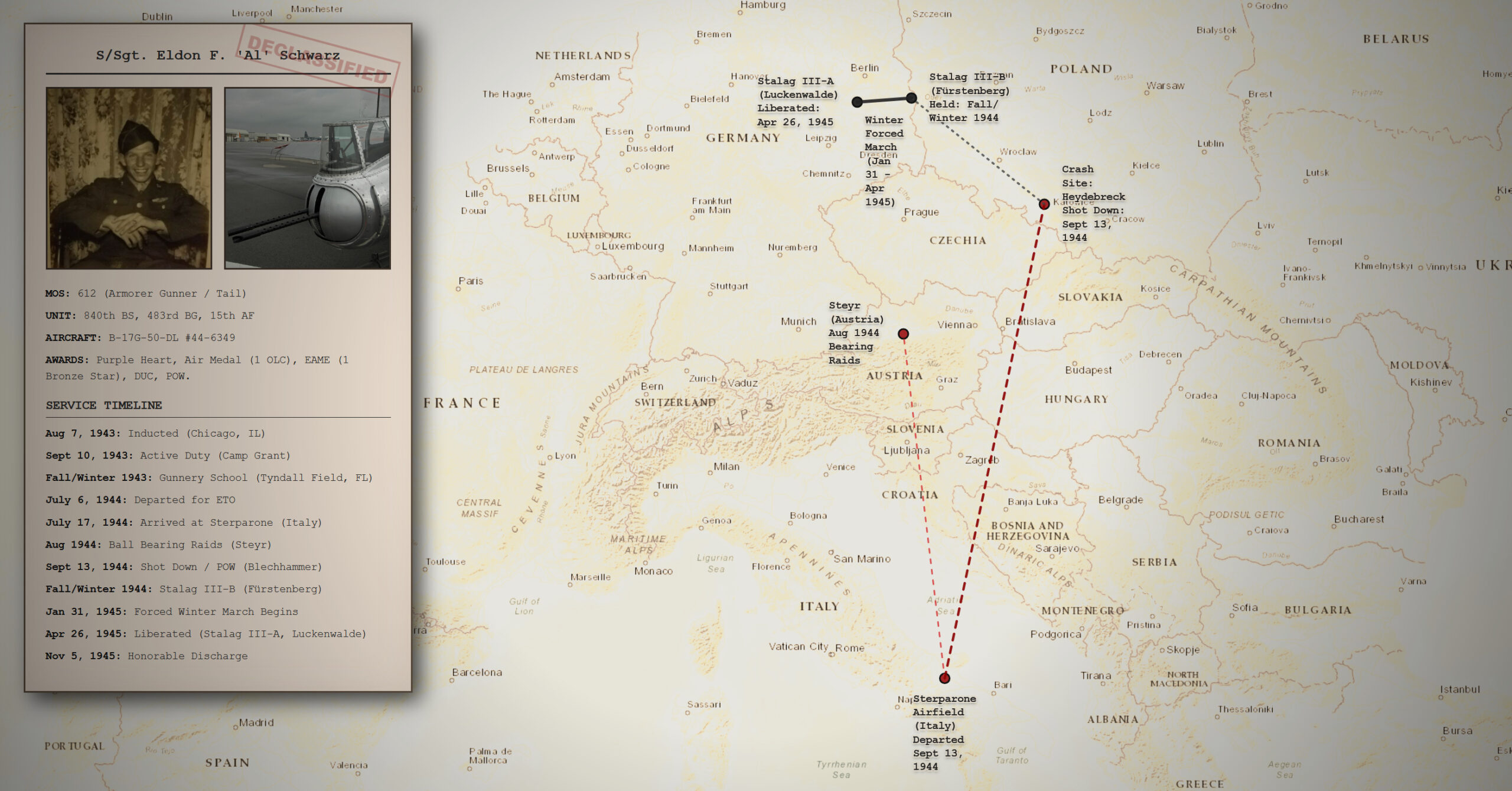
My grandfather, Eldon “Al” Schwarz, was one of those guys. He didn’t talk much about the war. Guys from that generation mostly just kept their mouths shut, came home, went to work, and dealt with it. Back in 2012, I got a phone call right after New Year’s about his World War II service, and ever since then I’ve been piecing together the whole truth. Digging into his military discharge papers, old Missing Air Crew Reports, and the signed photo of his crew puts together a story that hits hard. He lived through absolute hell five miles up in the air, and he was the only guy on his crew to walk away from it.
The Training: Camp Grant to Tyndall Field
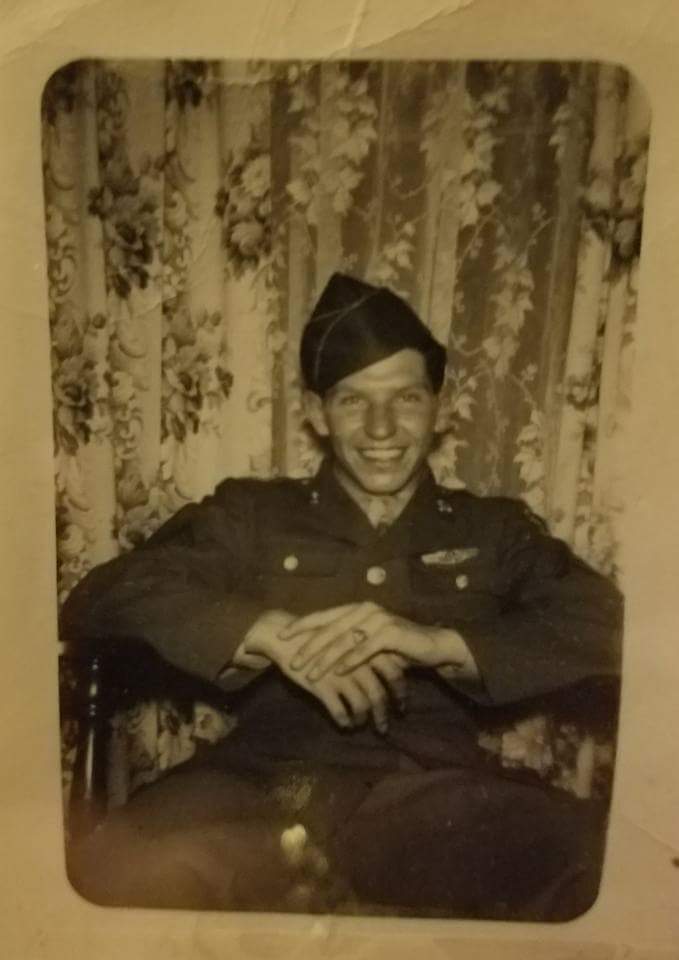
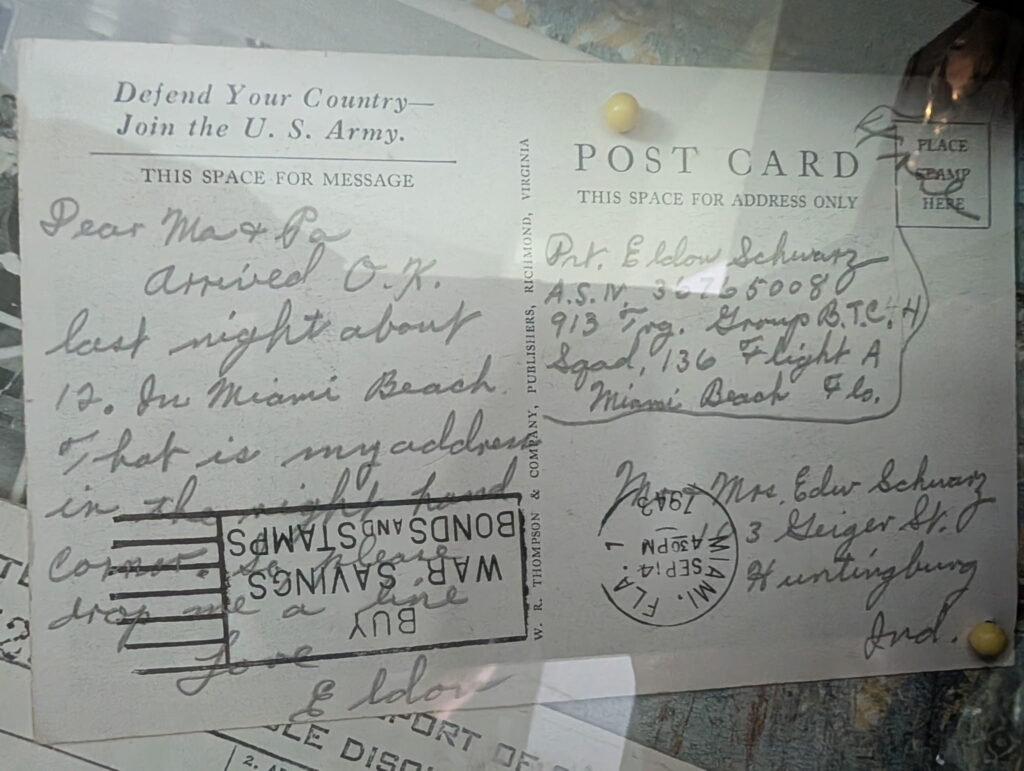
Grandpa was born in Dubuque, Iowa on March 15, 1925, and grew up on the Northwest Side of Chicago on Kedvale Avenue. He was an 18-year-old vocational high school student when he was inducted on August 7, 1943, entering active service on September 10, 1943 through Camp Grant right up here near Rockford. Because he already had a head for mechanics, the Army Air Forces decided he belonged in a heavy bomber and sent him down to the Flexible Gunnery School at Tyndall Field in Florida.
Back then they didn’t just teach you how to point twin .50s. Shooting from a moving bomber at a 350-mph fighter plane in three-dimensional space is pure physics and deflection lead—if you aim directly at a fighter crossing your tail, your bullets are going to miss hundreds of feet behind him. At Tyndall, they put recruits on the back of moving flatbed trucks rattling down dirt tracks firing 12-gauge shotguns at clay pigeons to wire their brains for relative motion, and then sent them up in North American AT-6 Texans over the Gulf to shoot live ammo with painted bullet tips at canvas sleeves towed behind other planes.
He graduated as an Armorer Gunner (MOS 612). That meant he wasn’t just pulling triggers; he was the guy who kept the weapons running when the temperature dropped to forty below zero. Standard gun oil turns into solid glue at altitude, so guns had to be stripped dry or run on ultra-thin graphite and kerosene mixes. He had to know how to tear down an air-cooled Browning AN/M2 .50-caliber machine gun blindfolded, set the headspace and timing with a feeler gauge so the barrel wouldn’t blow up or shear a bolt, clear nasty double-feeds with frozen fingers, and troubleshoot the electrical solenoids on the bomb-bay shackle racks if a bomb hung up. He pinned on his silver Air Crew Member Wings, got his sergeant stripes, and shipped out for Europe on July 6, 1944.
Sterparone and The Ball Bearing Raids
He landed in Italy on July 17, 1944, assigned to the 840th Bomb Squadron, 483rd Bombardment Group (Heavy), 15th Air Force, flying B-17 Flying Fortresses out of Sterparone Airfield.
Sterparone wasn’t some fancy paved air base. It was basically a giant, dusty dirt field on the plains outside Foggia laid out with interlocking Pierced Steel Planking (PSP) for runways, baking in 100-degree Mediterranean heat, with the guys living in canvas wall tents pitched in the olive groves. When sixty-thousand-pound taildraggers taxied down that steel matting, it sounded like a freight train rolling over loose sheet metal.
His discharge sheet shows he earned the Air Medal with an Oak Leaf Cluster. In the 15th Air Force, you didn’t get that for just showing up; it represented around ten completed combat missions. I remember him talking about bombing ball bearing factories. That lines up with the 483rd’s mission logs for August 1944, when the group was repeatedly sent across the Alps to hammer the Steyr ball bearing and aircraft engine complexes in Austria and rail junctions feeding the RIV bearing plants in northern Italy, trying to seize up the German war machine by starving it of precision bearings.
The Brothers in the Photo
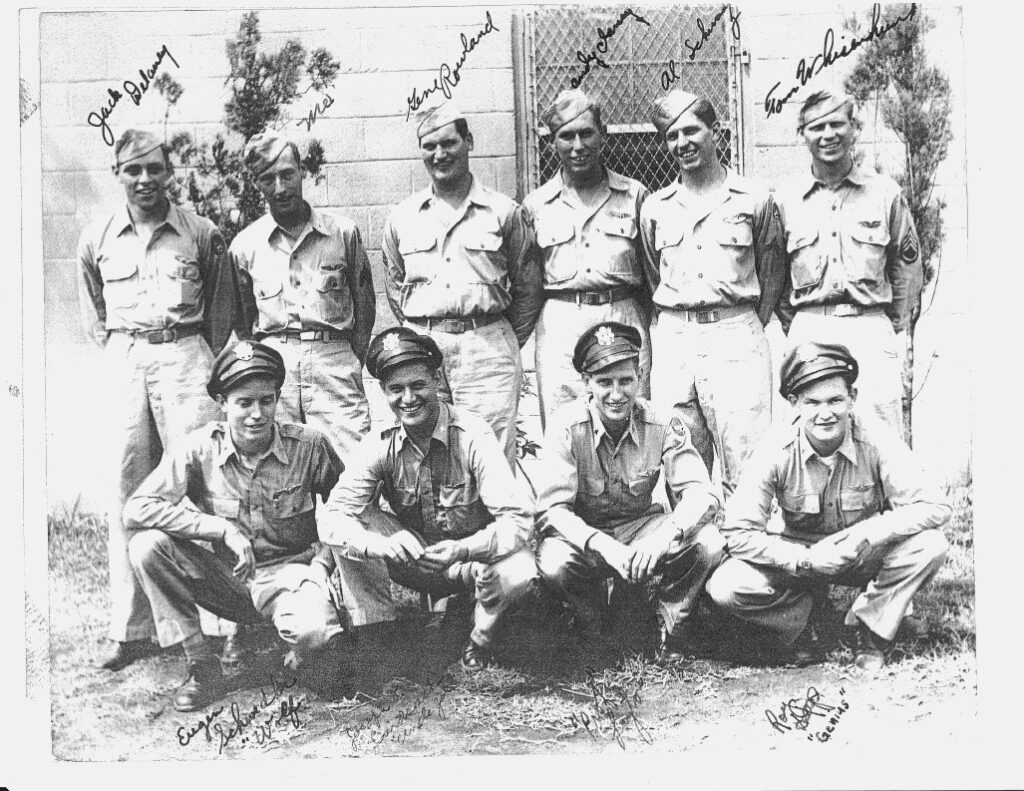
Before deploying overseas, these crews trained together stateside. We have an original crew photo signed by the guys standing outside the barracks. Standing on the back row, second from the right, is my grandfather, signed clearly as “Al Schwarz”.
Standing beside him on that back row are the other enlisted crewmen: Jack Delaney, Gene Rowland, Andy Clancy, and Tom Whisenhunt (along with the crewmate labeled “me” who originally owned the print), and kneeling in the front row second from left is co-pilot George Layton.
They trained together, learned each other’s voices over the interphone, and all nine of those men in that picture would be locked into the exact same airframe with Grandpa on his final flight.
The Machine: B-17G-50-DL #44-6349
If you love old iron and aviation mechanics, the specific airplane they flew that day has a documented history right down to the day it rolled off the line.
It was a B-17G-50-DL, serial number 44-6349, built under license by Douglas Aircraft at their Long Beach, California plant. Production logs show it was delivered to the Army Air Forces at Hunter Field, Georgia on July 11, 1944, staged north through Dow Field in Bangor, Maine on July 26 to fly across the Atlantic, and arrived at Sterparone to join the 840th Bomb Squadron on August 2, 1944. By September 13, that airframe had only been in combat for six weeks.
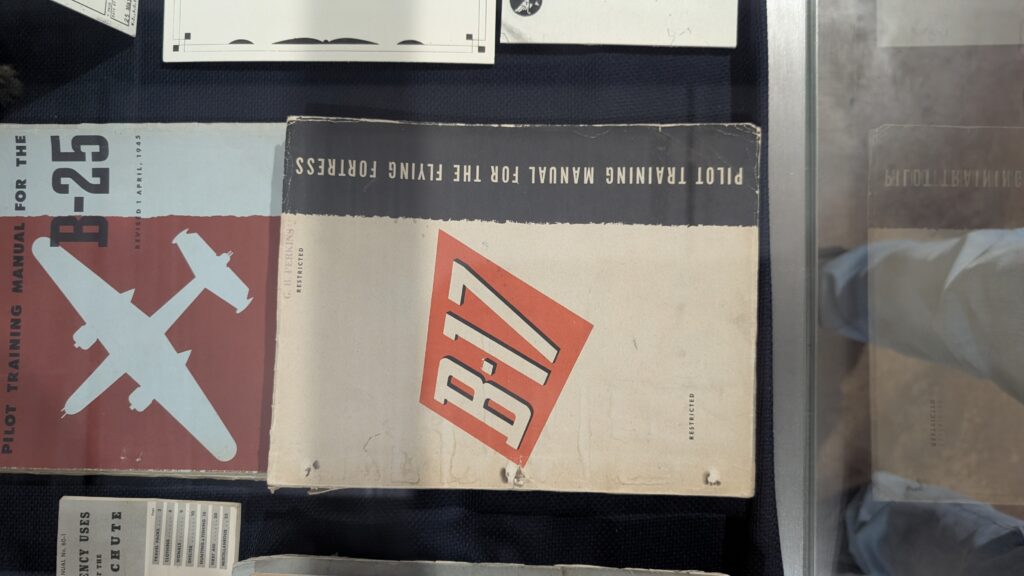
The “Block 50” Douglas G-model was a beast of a machine:
- Markings: It was delivered in bare natural aluminum with no green camouflage paint to shave weight and drag, carrying the 483rd Bomb Group’s distinct tail markings: a bright red rudder and a bold capital “Y” over a Five-Pointed Star painted on the upper vertical fin.
- Engines & Turbos: It was pulled through the air by four Wright R-1820-97 “Cyclone” 9-cylinder supercharged radial engines—1,823 cubic inches each, cranking out 1,200 horsepower per engine on takeoff. Because a naturally aspirated engine suffocates up high, each nacelle had a General Electric B-22 exhaust-driven turbosupercharger glowing cherry-red in the bottom of the cowling, compressing freezing -45°F air at 25,000 feet so the engines could still pull sea-level manifold pressure on 100-octane leaded avgas.
- Constant-Speed Feathering Props: Up front were four 3-bladed, 11-foot-7-inch Hamilton Standard Hydromatic constant-speed, full-feathering propellers. Anyone who flies constant-speed props knows how critical that system was. If flak or mechanical failure blew an oil line or a cylinder off a radial at altitude, the prop governor lost control and the prop would windmill wildly in the 160-mph slipstream—creating so much asymmetric drag and vibration it would tear the engine right off the wing or throw the plane into a spin unless the pilots hit the big red feathering button on the overhead panel to twist the blades edge-on into the wind.
- Heavy Tailwheel Geometry: Fully loaded with fuel, ammo, and bombs, a B-17G weighed over 65,000 pounds sitting on conventional taildragger gear. With those four massive radial noses blocking the view ahead, pilots had to S-turn down the steel planking, steering with differential toe-brakes and goosing the outboard #1 and #4 throttles before locking the tailwheel straight for the takeoff roll.
- Cable Controls & The C-1 Autopilot: There were no hydraulic flight controls on a B-17. The massive rudder, elevators, and ailerons were muscled directly by braided 1/8-inch steel cables running through pulleys down the length of the fuselage. On the final bomb run, the pilots flipped on the Minneapolis-Honeywell C-1 electronic autopilot, which slaved the flight controls directly to the Norden M-9B bombsight in the nose. For the last few miles to the target, the bombardier literally flew the entire bomber using the knobs on his bombsight to hold a dead-flat track while walking right through the flak.
- Ordnance & Armament: On a 1,200-mile round-trip oil raid over the Alps, the bomb bay typically carried 500-pound AN-M64 or 1,000-pound AN-M65 General Purpose demolition bombs hung on vertical shackles. They were rigged with 0.025-to-0.1-second delay fuses so the heavy steel casings would punch straight through reinforced concrete refinery roofs and steel cracking towers before detonating inside. For defense, the ship bristled with thirteen Browning AN/M2 .50-caliber machine guns cycling at 800 rounds a minute, fed by roughly 6,000 rounds of armor-piercing and incendiary belts.
- The “Cheyenne” Tail Station: As a Block 50 ship, #44-6349 had the updated Cheyenne tail turret—a wider plexiglass enclosure with an optical reflector gunsight and twin .50s fed by flexible steel chutes from ammo cans mounted forward of the tailwheel well.
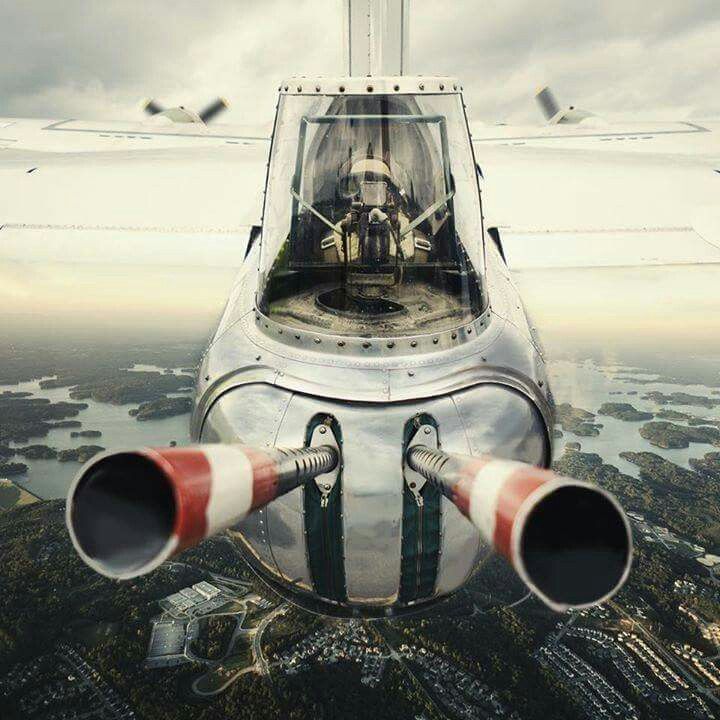
Even with the Cheyenne upgrade, the tail gunner position was the coldest, loneliest real estate in the sky. To get back there, you crawled on your hands and knees down an uninsulated aluminum catwalk over the open tailwheel well. You wore a 24-volt electrically heated “bunny suit” under your shearling gear that acted like toaster wire—if a wire shorted when you bent your knee, it burned you; if the circuit died, you got frostbite in minutes. You breathed through a low-pressure A-14 demand oxygen mask where the condensation from your breath constantly froze into solid ice plugs, meaning you had to squeeze and flex your rubber mask every few minutes or pass out silently from hypoxia in sixty seconds.
And you couldn’t wear your parachute on your back. It was too tight. You wore a QAC (Quick-Attachable Chest) harness with two heavy forged steel snap-hooks on your chest, while your 24-foot canopy pack hung on a bracket behind you. You knelt on a tiny bicycle saddle, boots resting against the rudder pedal kick-plates, gripping the twin spade handles, staring through four inches of bulletproof glass at the entire sky behind the formation.
September 13, 1944: Blechhammer North
Then came September 13, 1944.
The target that day was the Blechhammer North Synthetic Oil Refinery in Upper Silesia (modern-day Poland, just miles from Auschwitz). Germany didn’t have natural crude oil wells, so they ran their whole military on synthetic aviation gas and diesel made from coal hydrogenation at massive chemical plants. Because that fuel kept Hitler’s panzers and Luftwaffe fighters moving, Blechhammer was ringed with over a hundred radar-directed heavy 88mm and 105mm flak guns and hundreds of chemical smoke pots that drowned the valley in artificial fog. The crews called it “The Black Hammer” or just “Flak Alley.”
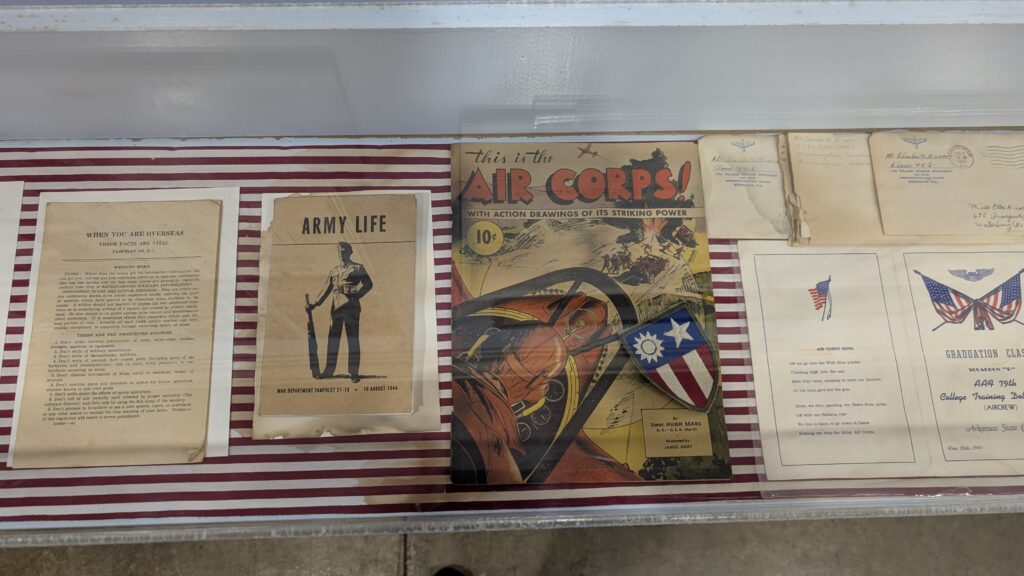
The Crew on Plane #44-6349 (MACR 8448)
There was ten men on that Fortress that morning:
- 2nd Lt. Joseph F. Condraski – Pilot (KIA)
- 2nd Lt. George C. Layton – Co-Pilot (KIA)
- 2nd Lt. Melvin S. Hershon – Navigator (KIA)
- S/Sgt. John J. “Jack” Delaney Jr. – Bombardier (KIA)
- T/Sgt. Thomas F. Whisenhunt – Flight Engineer / Top Turret (KIA)
- T/Sgt. Eugene B. Rowland – Radio Operator (KIA)
- S/Sgt. Kenneth E. Jordan – Waist Gunner (KIA)
- S/Sgt. Andrew N. Clancy – Ball Turret Gunner (KIA)
- S/Sgt. Richard G. McNerney – Waist Gunner (KIA)
- S/Sgt. Eldon F. “Al” Schwarz – Tail Gunner (Sole Survivor / POW)
11:00 AM Over Heydebreck & The Wire
As the 483rd climbed toward the Initial Point (I.P.) to start the bomb run, trouble hit #44-6349.
In Missing Air Crew Report 8448, fellow pilot 1st Lt. Wesley D. Hulse gave an eyewitness statement of what happened right before they entered the target box:
“Airplane number 44-6349 dropped out of the formation at about 1100, just before the I.P. Apparently, he was drawing excess power to keep up with the formation. Ship 849 took his place, and when 349 was last seen, he was dropping back. The ball turret gunner on my ship lost sight of him…”
Fighting a mechanical fault and pulling everything the engines had just to stay with the group, #44-6349 was forced to drop back out of its slot right over Heydebreck—directly beneath the guns of the Flak-Brigade Oberschlesien.
Caught out of the formation in intense radar-directed flak and suffering catastrophic failure, the bomber went down. When a sixty-thousand-pound Fortress snaps into an uncontrolled dive or breaks apart at altitude, centrifugal G-forces pin the crew against the aluminum bulkheads like lead weights—pulling yourself three feet against multiple Gs in heavy flight gear to reach an escape hatch is physically impossible.
Back in the tail section, Grandpa managed to snap his chest pack onto his harness, and as the ship broke apart, he was blown clear into the sub-zero slipstream, wounded by shrapnel and the violence of the breakup. Falling through five miles of smoke-filled sky, he found the steel D-ring on his chest pack, pulled the ripcord, and deployed his canopy.
All nine other guys on his crew rode the wreckage down into Heydebreck. None of them survived.
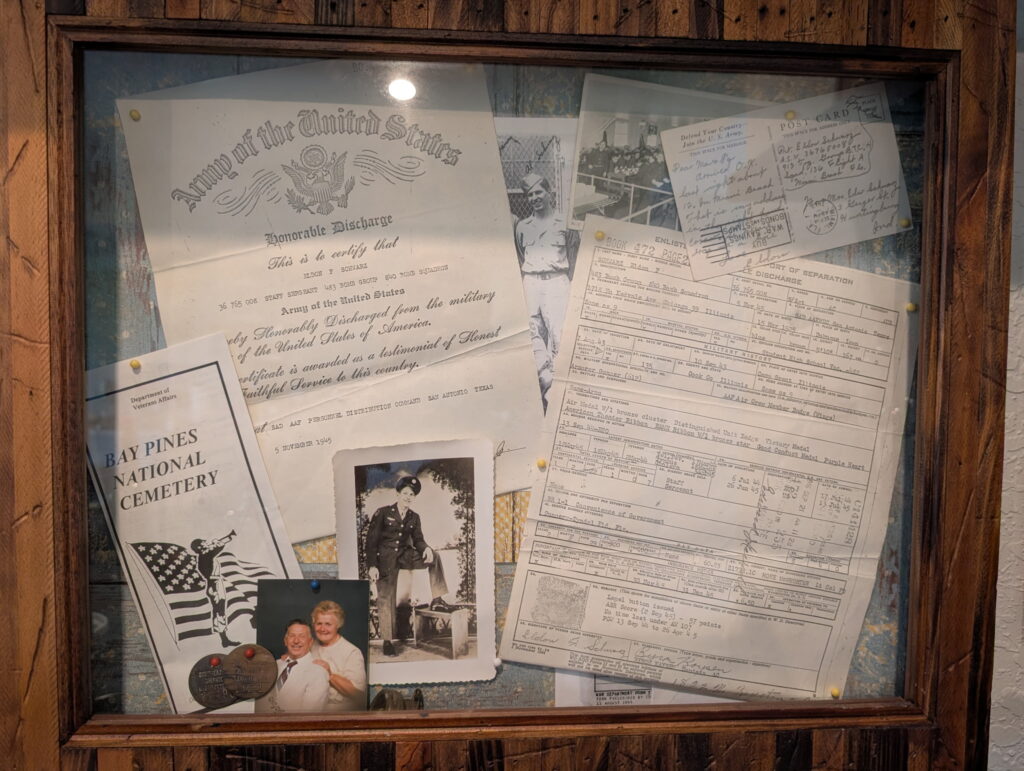
Grandpa hit the dirt wounded and was immediately captured by German forces. His military discharge paper states it plain as day in Box 55: “POW 13 Sep 44 to 26 Apr 45.”
National Archives POW records show he was hauled north along the Oder River into Stalag III-B at Fürstenberg. He spent that bitter autumn and early winter behind barbed wire surviving on starvation rations of watery turnip soup and black bread stretched with sawdust.
On January 31, 1945, with the Soviet Red Army smashing up to the banks of the Oder River, the Germans evacuated the camp in the middle of a blizzard. Grandpa and thousands of other prisoners were forced onto the frozen roads on a brutal winter march west across Brandenburg in sub-zero snow, sleeping in barns and ditches, eventually reaching Stalag III-A near Luckenwalde, south of Berlin. He hung on through the freezing cold, dysentery, and starvation until Allied forces finally overrun the camp and liberated them on April 26, 1945.
Medals & What It Took to Earn Them
He shipped out of Europe on June 26, 1945, got back to the States on July 13, 1945, and received his honorable discharge at San Antonio on November 5, 1945.
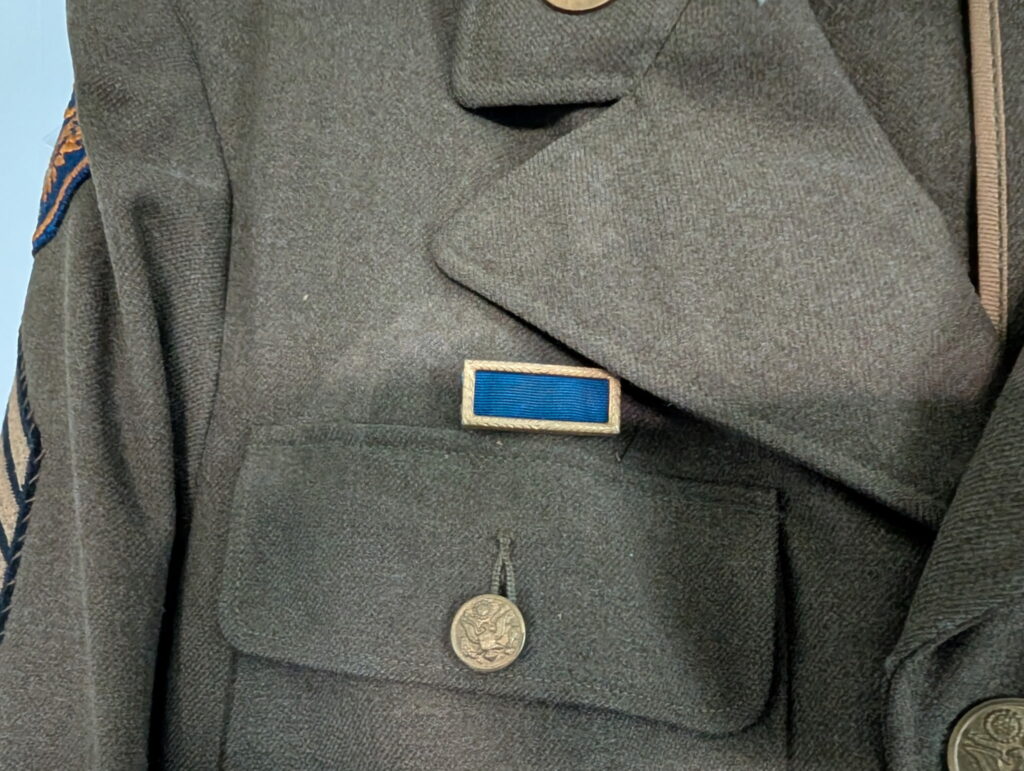
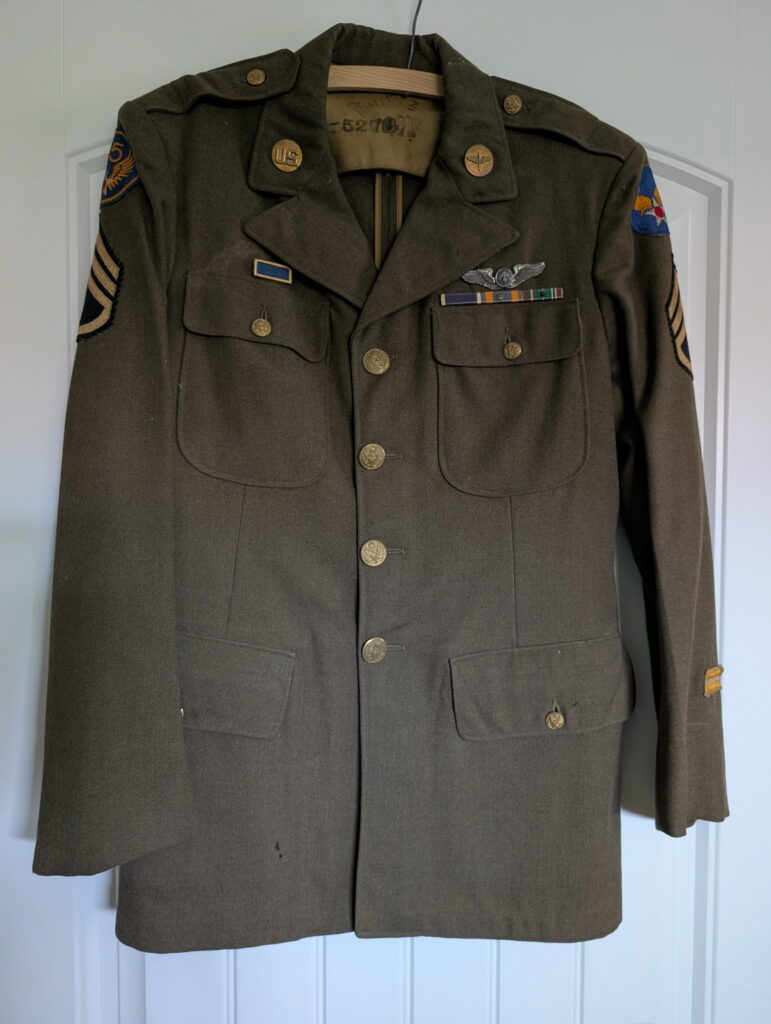
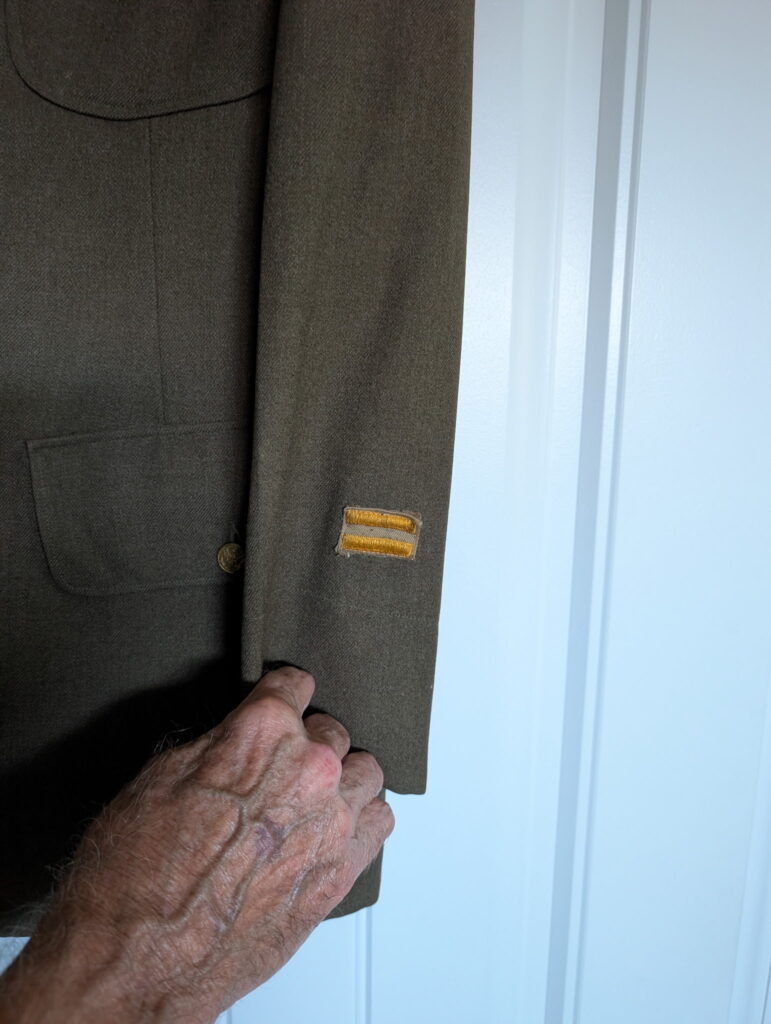
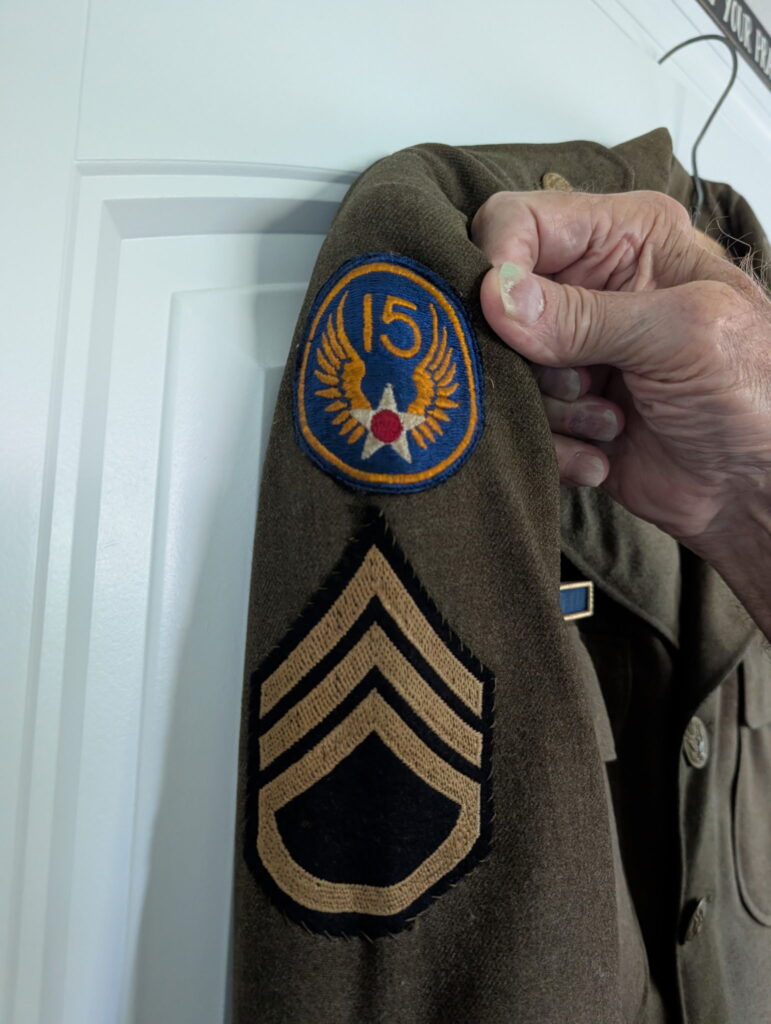
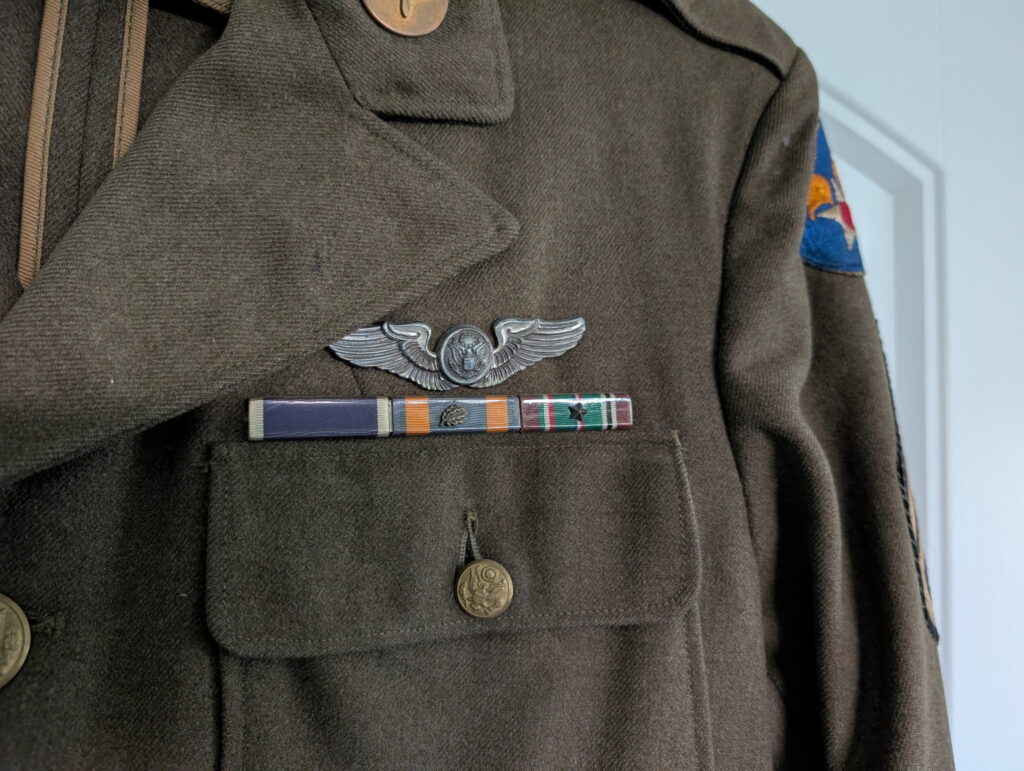
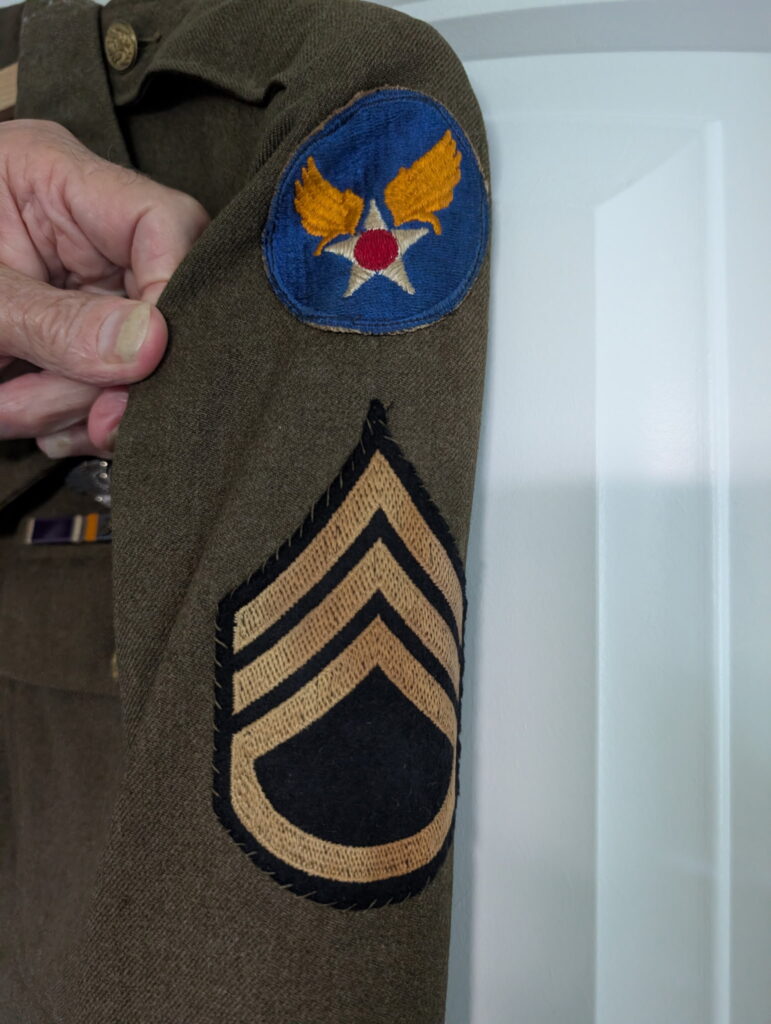
The military didn’t hand out medals for participation back then. Every single ribbon stamped on his WD AGO Form 53-55 had specific, strict criteria behind it:
- Purple Heart: Awarded only for being wounded or killed as a direct result of enemy action. Box 34 notes the exact date and theater: 13 Sep 44 – ETO. Shrapnel and the violence of the breakup caught him when #44-6349 went down over Heydebreck.
- Air Medal with 1 Bronze Oak Leaf Cluster: Established for meritorious achievement while participating in aerial flight. In the 15th Air Force, the standard requirement was completing five operational combat sorties against the enemy for the basic medal, with each additional Bronze Oak Leaf Cluster requiring another five combat missions. Having one cluster meant he logged roughly ten full combat flights before September 13.
- Distinguished Unit Citation (Presidential Unit Citation): Awarded to an entire military unit for extraordinary heroism in action against an armed enemy. The unit had to display such gallantry, determination, and esprit de corps under extreme conditions that it set them apart from other units. The 483rd Bomb Group earned this for their famous July 18, 1944 strike on Memmingen, Germany, and their March 24, 1945 raid on Berlin.
- European-African-Middle Eastern (EAME) Campaign Ribbon with 1 Bronze Star: Awarded for active service within the European Theater between 1941 and 1945, with the Bronze Service Star recognizing active participation in the Rome-Arno campaign.
- World War II Victory Medal: Awarded for honorable active federal military service between December 7, 1941, and December 31, 1946.
- American Theater Ribbon: Awarded for active duty service within the American theater boundaries during the war.
- Good Conduct Medal: Awarded to enlisted men who demonstrated exemplary behavior, efficiency, and fidelity in active wartime service.
- AAF Air Crew Member Badge (Wings): Required graduating from an accredited Army Air Forces flight school and qualifying in an active combat flight crew specialty—earned at the Tyndall Field Flexible Gunnery School.
What Veterans Day Means
On his veteran marker today, it lays his life out in stone in just a few lines:
ELDON F SCHWARZ
SSGT USAAC WWII PH POW
MAR 15 1925 – NOV 7 1997
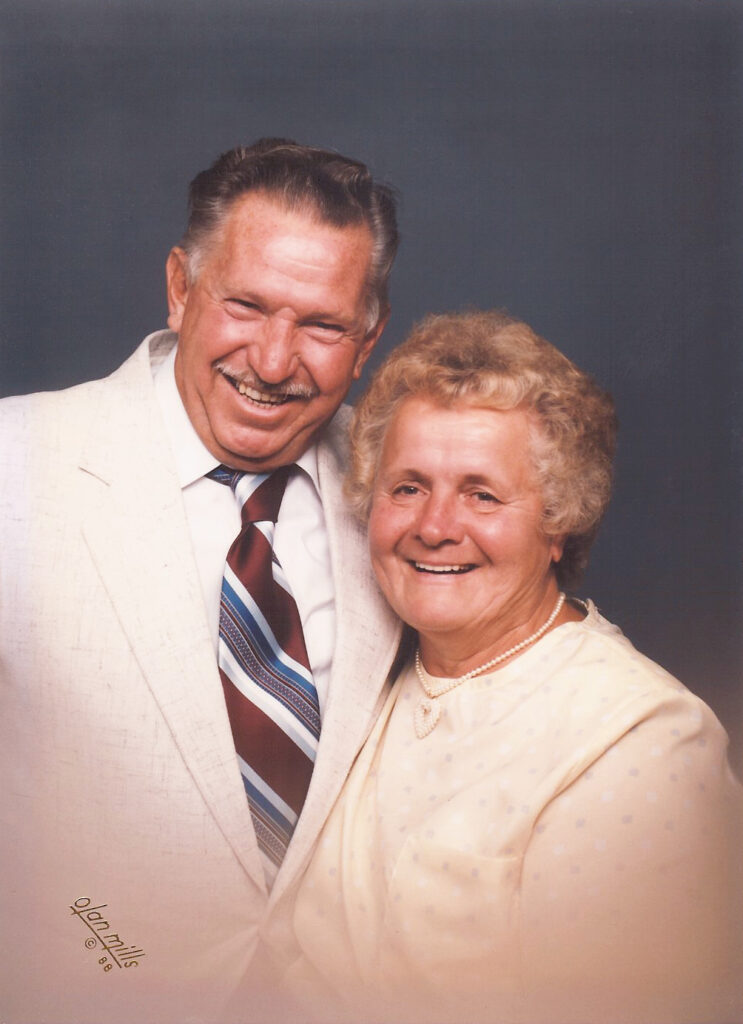
HIS WIFE FRANCES
FEB 24 1929 – APR 1 2003
DEVOTED PARENTS
He was just nineteen years old when he sat behind those twin .50s over Blechhammer. He came home to Chicago, married my grandmother Frances, raised a family, and worked hard his whole life. But he had to live the rest of his years carrying the memory of that freezing turret, the forced marches through the snow, and the nine brothers on his crew who never got to come home and grow old.
That’s what Veterans Day is really about. It’s about respecting the men and women who stepped up, took the hits, survived the unthinkable, and had the quiet grit to come home and build a life.
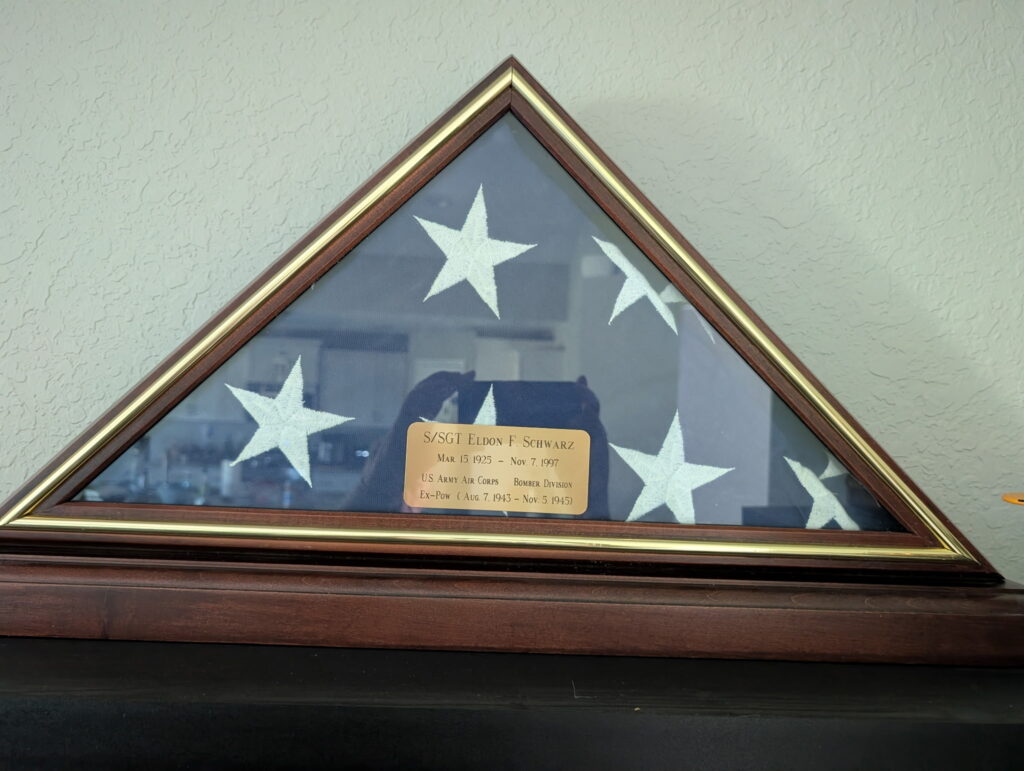
Here’s to Staff Sergeant Eldon “Al” Schwarz—the nineteen-year-old tail gunner from Chicago who went five miles up into the flak, survived the fall, and made it back.



Leave a Reply